Monday, April 23, 2012

connections


       After doing this weeks after on chapter 12 and 13 in Barker’s text, and then comparing the movies (Rebel Without a Cause, Lost in Translation) to the different ideas and theories that our textbooks presents was beyond interesting for me.  I know I seem to say this every time, but sometimes it is hard for me to make a connection with limited examples.  However, I want to spend time talking about Capitalism and Urbanization because those are the two that really popped out at me, and that I came to a clearer understanding of after comparing and thinking about what the text says and the movies.  I have never seen Rebel Without a Cause but I had seen Lost in Translation.  Yes, there were plenty of examples in Rebel Without a Cause that could be compared to the text, but I really want to write about Lost in Translation.  Why? Because up until now I would have never tied this movie to urbanization, capitalism, post modernism, and other things that our text covers if I had not been ‘trained’ to think outside the box/critically or how this relates to these elements.                                                           
   I had seen Lost in Translation about four years ago and enjoyed it, viewing it as a film with a surface plot, like most people probably do.  I liked the idea of the bond between the two characters, and how Bill Murray’s character, Bob Harris, is sort of over his fame hype but has to deal with the cultural imperialism of another country’s hype and excitement to work with him.  I think with the second go around of this movie, I loved being able to understand the whole idea of cultural imperialism, urbanism, and capitalism as major elements to this film.  One of my favorite scenes in the movie is when the Japanese director is photographing Bob and is giving words trying to prompt specific looks asking for “Rat Pack”, “You know Sinatra?” and “Roger Moore”.  This is a perfect example of cultural imperialism and how popular culture can be spread so fast via media.  The photographer knows many elements and ‘personalities’ that are from America that he ask Bob to channel the the photos.    
       In our textbook, Chris Barker writes about capitalism and urban places saying, “Capitalist corporations continually promote commodification and the search for new markets” (Barker, p. 382).  In the case of Lost in Translation all the efforts of Bob being in Japan is to sell a whiskey, however, they (ad companies, and marketing) use many techniques that were directly connected to the U.S.  I agree 100 percent with the idea that capitalist corporations enforce and encourage commodification.  There is nothing that is not driven or motivated by profit.  Today’s society is a constant reminder of this as we see things unfairly advertised in order to gain customers. Last year I took a class that focused on the idea that we are a buying country, we are willing to spend money with the promise that it’s the newest, best, and fastest.  Lost in Translation is just one insight to the idea that America makes money not only here, but by spreading out throughout the world.  People today know Japan to be one of the fastest moving countries and despite recent shut downs of electronic factories, this movie is a prime example of urbanization of a country over a short amount of time.  Kind of makes you step back and think... Hopefully.  xx  

Monday, April 16, 2012

oh annie...


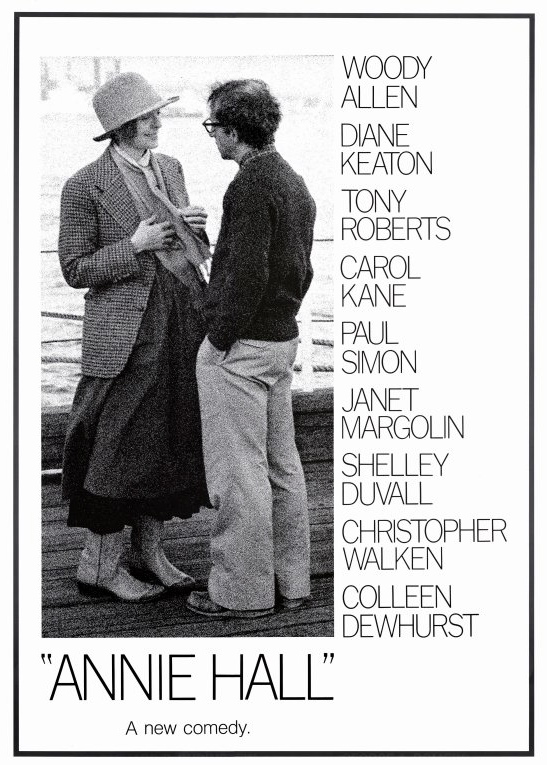
      Ok, ok....I'm not going to lie. Watching Annie Hall for the first time I couldn’t help but think; ‘this is the slowest, old people’s entertainment, not funny or realistic movie that I have ever been forced to sit through’.  However,  when I started to see that it could be considered a base for a lot of the movies I’ve seen today, it was fun to pick out themes and techniques that have been replicated today.  It was also interesting to view it with the idea that the film could be argued either Modernism or Postmodernism.  I saw the movie  Annie Hall as a Postmodern film because while it was not necessarily  the first film to ever break the forth wall, or “erase the boundaries between art and everyday life,” it was however a film that included both of those things along with taking the sex and rom-com style and themes and put them into a very real and relatable depiction of love and relationships.  The movie in a sense has a very raw feeling to it that made me start linking it to all the other films i had seen that could be considered Postmodern.
       I would like to talk about a film that is well know with today’s generation.  I am totally and fully aware that I’m not the first to say it, the film 500 Days of Summer is a very reflective, and a very modern day Annie Hall.  You wouldn’t believe (or maybe you will) the amounts of scrutiny that I get when I tell someone how much I despise the film 500 Days of Summer.  And I literally can’t tell you how many discussions I have had with friends and even random strangers when they find out that I don’t like this movie.  But when I told my (older) sister that I didn’t enjoy Annie Hall, she got on my case.  and while I know that this seems totally unrelated, I just want to point out that my old fashion, realistic loving, relationship and love obsessed sister makes the same arguments in defending Annie Hall as those defending 500 Days of Summer do.  And in both parties defense, I should give more respect to both films for doing what we rarely see today, and achiving what always complain that there is not enough of...showcasing relationships in a realistic and highly relatable light, while still connecting to the audience and in some parts in Annie Hall, addressing the audience. 
      which brings me to my next point.  Woody Allen was not the first to make a movie where a character addresses the camera and breaks that forth wall.  However, the popularity of this now classic movie has inspired other movies to mimic the irony in a character breaking that barrier and addressing the audience as if they were their friends and either try to help the audience see their point, or inform them/catch them up on something that is going on.  Ferris Bueller’s Day Off, Fight Club, Yours, Mine and Ours (1968), and even The Emperor’s New Groove, are all films that have either the main character, or the film’s narrator address the audience in a nonchalant manner.
       Annie Hall is now a movie that we can look at and get a understanding for Allen’s style and ideas behind movies and see that he perhaps made this movie in hopes that it would spark the sort of thinking that it did for me while understanding that it was intended to have some sort of depth and meaning to it.  We can also see that because of the captivity that it took it’s viewers by, other films have admired and ‘borrowed’ Allen’s classic style.  Yet I still feel that as far as storyline/plot goes, 500 Days of Summer is a perfect example of, a real life situation, portrayed in a film, while depicting elements of Postmodernism, a modern day Annie Hall

Tuesday, April 10, 2012

sex and romanace in today's entertainment


        Most of by young teen and adulthood know that sex has been around ever since the first two living things walk the earth.  In the very early years, sex was a way to create life, it was something that was instinctual, natural, and vital to continuing the circle of life.  “The History of Sexuality” by Michel Foucault shows us all of this.  He writes about how sex for humans in the 18th and 19th century were strictly for creating a life, and that the purpose of creating life differed from the animal way of doing it.
       
It’s not like I was completely in the dark about this, I was well aware that the ideas of the purposes of sex have changed.  Especially considering that today’s culture (with the help of media) has glamorized sex and sexuality to the most positive extend and the ugliness of sex (STDs, AIDS, infections, rashes, and other painful and health threatening illnesses that can be contagious via sexual intercourse) has been put off to the side almost as if it doesn’t exist.  Relating to today’s sexual issues, it is clear that if sex helps sell things, it is easier to jump on and use sex to your advertising and selling advantage.  Even more now that sexuality comes with such a positive light shone on it.
       The whole “sex” subject is something that I want to spend a little bit of time talking about because I personally don’t think it gets enough attention.  I asked a few friends and my roommates what was the first thing that comes to mind when they hear the word “sex”.  Their responses varied from; “Chris”, “orgasm”, “gender”, and “hot”.  Not one of them used a “negative” word to associate with the action between two people.  I think that it is interesting to see movies do the same thing...not only do most movies exclude any of the negative things about sex and romance (I guess romance ‘negatives’ would include things like getting screwed over, cheated on, a broken heart, etc.), but they can tend to over exaggerate the friendships and/or relationships that people have with those who they are sexually involved with.  Now don’t get me wrong, I’m sure writers often use personal experiences and the stories of others as a base to write these plots and scenes that include sex and romance comedy, but at the same time it’s like the distortion of these stories have gotten more and more exaggerated over time.
       I guess overall I feel bad for those who watch the newer romantic and sex comedies and don’t understand the extent of the exaggeration, and trust me one of my dear friends believes everything she sees in a rom-com, or don’t understand the evolution that has happened with sex and romance since it has been shown and portrayed in a comedic light.   To close up I want to point out, that since watching these older and early rom-coms I seriously understand my mother’s genuine shock at how far today’s rom-coms can push the limits.  In fact I hate admitting this, but sometimes I’m shocked that some racy scene or joke actually made the final cut in a movie!  Here’s to hoping I can teach my future kids, friend’s kids, and nieces and nephews what they need to know and understand to appreciate rom-coms and sex comedies, and here’s to hoping they listen to my wise words and lectures! :} xo

Monday, March 19, 2012

seeing the sex and romantic comedic side in "10"


        One of my first thoughts about watching romantic comedies from the 70s and before compared to the romantic comedies that I see today, was that the comedy element in the 70s movies focuses more on real life problems or incidents that if they happened to you, you would only be able to laugh when looking back it.  To where the comedy element in today’s movies tend to be these obvious jokes that most often the characters (and the viewer) recognize as funny as soon as the happen.
Even thought the movie and story elements have stayed the same over the years, the type of humor and comedy has changed making it hard to see the relation and the similarities between the movies made back in the 70s versus today.  However, after learning and understanding the characteristics that are a part of the radical romantic comedy, it is clear that the characteristics are still there, just in a different form.
        One of the main characteristics I saw throughout the movie “10”, was the “masquerade” element.  In comparing to the article, the movie “10” has the male lead, George, take on the masquerade elements as he knows he is unhappy with his age, and has his mid-life crisis.  His girlfriend and friend/partner know that something is wrong with him as he shares a little about how he’s feeling.  But when he up and flies to Mexico in order to hunt down Jenny, they do not know about his whereabouts, or what he has been feeling with jenny.
        As far as “self-reflexivity” goes, I believe it shows up in George, Sam,and Jenny as the characters display it in different areas.  I think George shows it as presenting a complex problems that’s still an ongoing battle with individuals today.  Many people have mid-life crisis’ and George getting this idea in his head that he has to have his perfect women, yet when he does get her, he realizes it was a mistake to go to such great lengths to pursue her.  This holding the ‘modern and more realistic form of romantic comedy’, seeing as that we still see this in rom-coms today, and as well as it being an actual struggle for some.
        The women of this film are interesting in contrast to one another, yet still viewing them both in the aspects of self-reflexivity.  Both Sam and Jenny find sex to be an important part of a relationship, but Sam’s views are more traditional seeing that sex should be just between the two people in the relationship and neither of them lusting or desiring anyone else.  Jenny however clearly sees that the importance of sex is for showing love and appreciation even if it’s not with the other person you are in the relationship with.
       Unfortunately, I could not find the film anywhere online, so I didn’t see what happened, but I did look it up and read about the ending.  I thought it was an interesting second have of a movie because I would not have expected for Jenny and her new husband’s romance to have allowed George to sleep with Jenny.  That’s not something that’s common in today’s romantic comedies typical...yes, we sometimes see a lost and confused character have a crisis, and maybe even go on the chase, but it is rare for them to be chasing someone who is already married, and for them to get that married person.  By having George realize what he’s done and how outrageous it was for him to make the decision to chase newly wedded Jenny we return to the same formula that we see in sex and romantic comedies...it ends with boy getting girl.

Monday, March 12, 2012

old fashion rom-coms


        It’s funny that one can think that something is such a new genre and that my mother, for example, wouldn’t understand why “Rom-Com”’s are so appealing to me and my friends.  I sometimes get this idea that sticks that my mom (or other elders) can’t ever think of relationships or sex as comedic.  I was raised to respect love and the sanctity that marriage holds, but I guess because of this, I subconsciously thought that my mom never saw or understood that sex, romance, or relationships with various people could be made light of, or enjoy as they were made light of.  I guess what I most lacked was the understanding of what elements, or characteristics sex comedy holds...and because of not being aware of this, I failed to understand that sex comedy has been around for quite some time, and that my mother is well aware of what it is.
        To be totally honest, I don’t think I can name one romantic or sex comedy I’ve seen before the 90s, but I know they exist.  However, even when I do think back to the earliest 90s rom-com I’ve seen, it does hold the same characteristics that I see in the Jason Segel, Jennifer Aniston rom-coms that I find myself excited to see today.  I love this idea of “battling lovers” that The Sex Comedy talks about, because it seems to be a conflict issue that could literally be around for years to come (and if I saw a good old fashion romantic comedy, it would be believable still if it was part of the plot).  Men and women have their differences, obviously, and no matter what amount of time goes by, I think that biologically men and women will have different views on romance and sex.  This can bring forth the “hierarchy of knowledge” element into discussion which in a way leads us right to hegemonic masculinity arguing that men know more than women, yet “we” the viewers of said movie or situation, know more or better than both.
        Over all I think one of the things that grabbed me the most in the readings was that time doesn’t change reality.  Yes, true that there is mostly a specific image branded to romantic comedies, and that it can be easy to quickly judge that genre of book or movie as fictitious but in reality, regardless of the exact situation portrayed, all of the elements and/or characteristics discussed in the reading could easily take place in a relationship today.  People in relationships still experience emotions other than love before love itself, there tends to be a hierarchy of knowledge in almost any romantic or sexual relationship, “battle of wits” often shows up in relationships commonly before one really gets going or as one is ending.  As much as I’d like to think that relationships aren’t so textbook, it becomes clear to me that relationships are a comedy that whether or not I like it, have certain elements that don’t just change or disappear over time.


Monday, March 5, 2012

Casino Royale Presentation


        When it came time to pick the text for the presentation, I was completely torn.  Half of me wanted to do something that was closer to current times (the movie or social networking site) and the other half of me wanted to take a chance to learn about an older text and it’s relation to pop culture, structuralism, post-structuralism, etc.  I ended up choosing Ian Fleming’s Casino Royale because the fact that was written some years back still holds a great amount of popularity (movies that I enjoy today), not to mention the fact that this story and it’s main character has literally lasted generations, intrigues me.

        There are a few things that went into the preparation of this presentation,  the first of which was discussing the book as a whole and as a group.  We met a few times discussing the reading and the (possible) correlations that Casino Royale has to the class material, but after a few of those meetings I felt that we needed to break down what it was exactly that we all wanted to talk about and ask to get the class discussions going.  I set up two different meetings for the group so we could use this time to make sure that our subjects would not overlap and then asked the rest of the group in which style they would like to present.  During these two meetings we decided to composed a power-point as an outline for our audience to help keep them on track.  We each designed our own slide (shout-out to Nick for putting all the slides together/letting us use your computer!) which would contain what main points we wanted to talk about, along with pictures and clips that we felt demonstrated the points and ideas we wanted to bring up.  I am leading the discussion on Vesper and other topics containing women that interact with Bond and how the text Casino Royale’s elements differs from how women “should” be treated by a man in pop culture today.  In addition to setting up the meetings and designing my slide, I came up with the classroom activity idea.  We all discussed different ways to split up the classroom into groups, but I thought it would be fun to have trivia questions in between the different topics that we wanted to cover to break up the deep theory-relation thinking, and add a little fun, basic text (and movie) reference thinking.

        I seriously could not be happier with my text choice, but I have to say that I don’t ever think I’ll hear “James Bond” and not think about all the analyzing that I did in relating it to everything we’ve been learning in class.  I think it’s great that I know I have the ability and the desire to view things in a deeper, more objective way than I would have before.  I know that this is all part of learning but one of my favorite things about deconstructing a certain book, movie, or play is that the story resonates with me differently and every time I hear the title or plot being discussed I’m please that I know more than just the story.


Sunday, February 26, 2012

love according to Jerry


       Last year I did a group project about love.  We wanted the project to cover both scientific and biological aspects as well as emotional.  It was fun interviewing people, collecting, and reviewing the surveys and seeing what college attending people had to say about love.  Mostly people thought of it was a controlled emotion, you either feel for someone or you don't, you fall in love, you fall out of love... few thought of it as being biological or chemical.  Without going deep into the research we found, we did discover that love is both a emotional feeling that we develop as well as chemical reactions involving oxytocin, dopamine, and hormones acting as neurotransmitters giving us the biological part of love.
        In the movie Jerry Maguire, it covers a lot of life and personal choices between the relationships that Jerry has with his clients, girlfriends, fiances, wife, and ultimately himself the audience can see almost every type of love there is.  So if we ask ourselves what makes love possible in any of the relationships Jerry has in this movie, we see that there are multiple factors some of which we could find in our own love life’s.  First there is the selfish love that we see in Jerry.  At the beginning of this film we see how in love Jerry is with himself.  He loves his job, getting what he wants, himself, and his material things.  Jerry doesn’t care what lie he has to tell or who he has to backstab to get what he wants... he loves himself enough that he would do anything for himself.  By the end of the film, we see a change in Jerry where he starts to put others before himself, becoming more selfless then selfish.
        We see motherly love as Dorothy Boyd protects and cares for her young son thinking about his safety and health in the decisions she makes both in her career and personal life, and along with that, we see family love from Rod Tidwell as he strives to provide for his family and when he is injured we see the concern from his wife and family.  Another love that we see (and the main one of the movie) is the romantic love between Jerry and Dorothy.  Dorothy, again, displays selfless love that that both emotional and chemical as she take a leap and supports Jerry when he is fired and stays with him as he tries to continue his career as a sports agent.  Jerry however, seems to first feel chemical love for Dorothy, before it become emotional and he allows himself to fall in love with both Dorothy and her son.
       Today, I think that it’s rare to find a movie like Jerry Maguire with a subtle undertone and not overdone theme of love.  I feel like most movies are either about love specifically or have nothing to do with the emotional and chemical aspects or love.  But here’s the thing; I believe that pop culture has transformed love into any sort of relationship we have.  Work, personal, friend, family, sexual... pop culture often implies that love is a guaranteed thing in each one of those relationships.  Movies, music, clothes, food, and other material things are sold in a sex advertising way which I believe has now morphed with being the same thing as love.  Pop culture today takes the word love and uses it as a way to sell material goods rather then try to define or display its actual meaning.  Sadly, I think that because of this newer definition of love, many have lost sight and appreciation for the meaning of love, hopefully love will be re-redefined so once again the emotional, biological understanding of love will be popular.